
Scientists at Paderborn University develop secure and energy-efficient chips
Digitalisation is now permeating large areas of everyday life and the world of work. Complex algorithms and artificial intelligence (AI) can analyse ever larger amounts of data in a short space of time. Tasks such as autonomous driving or Industry 4.0 require processors that have to fulfil critical requirements in terms of energy efficiency, reliability, and security in addition to high computing power. The collaborative project "Scale4Edge" ("Scalable Infrastructure for Edge Computing"), which has now been completed, has created an ecosystem for simpler and faster development of semiconductor chips for special applications. In addition to Infineon Technologies AG as the joint project leader, scientists at the Heinz Nixdorf Institute at Paderborn University and 18 project partners, including industrial companies, other universities and research organisations, were also involved. The Federal Ministry of Research, Technology and Space (BMFTR) has funded the project with around 30 million euros over a period of 5.5 years as part of the "Future-proof special processors and development platforms" (ZuSE) initiative.
Edge computing: the future of decentralised data processing
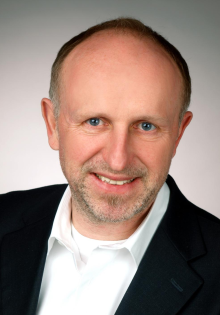
The collaborative project researched how the development time and costs of application-specific edge processors can be significantly reduced. In edge computing, data is not processed and stored in centralised clouds or data centres, but rather where it is generated, i.e. decentrally at the edge of networks, e.g. in factory halls, in the office, on the shop floor or in the office building. e.g. on factory floors, in medical technology or in road traffic. "Edge computing not only makes the digital transformation faster, but also smarter, more efficient, more secure, and more precise, as well as enabling an almost immediate response to events," says Prof Dr Wolfgang Müller, Project Manager at the Heinz Nixdorf Institute. Edge computing opens up new possibilities, particularly in sensitive and time-critical industries such as manufacturing, healthcare and transport technology: predictive maintenance in production or faster medical diagnostics based on patient data. By using powerful AI-enabled computers, companies can meet the increased demand for speed, scalability, and security.
RISC-V for secure and powerful edge chips
The work of the scientists at Paderborn University focused on the design and testing of reliable RISC-V processors for demanding applications. RISC-V is an open instruction set architecture that allows developers to design new (edge) processors quickly and cost-effectively - without licence fees, but with open, transparent, and therefore trustworthy technology. The result: commercially available, customised processors that are particularly reliable, performant, and robust, embedded in a scalable and flexibly expandable development platform. In cooperation with the Leibniz Institute for Innovative Microelectronics (IHP), the researchers have also developed several methods and components for fault-tolerant process architectures. In particular, they have successfully developed fast data interfaces such as "SerDes" (for efficient data transmission) and "CDR" (for error-free data transmission) in several technologies and brought them into production. These are crucial components for modern 22-nanometre (nm) and 130nm chips, which transmit data quickly and reliably even under difficult conditions. The scientists have also realised an implementation of the HiRel TETRISC architecture and made parts of it freely available (open source), which enables secure and sustainable chip development.
"Scale4Edge sustainably strengthens Germany's technological sovereignty: the development of commercially available, innovative processor architectures, software solutions, and verified security approaches for edge applications not only consolidates national expertise in semiconductor and system design, but also increases data sovereignty in the end application - in the spirit of a secure, independent, and sustainable technology system," summarises Prof Müller.
This text was translated automatically.